WELCOME TO ALFRAGANUS UNIVERSITY
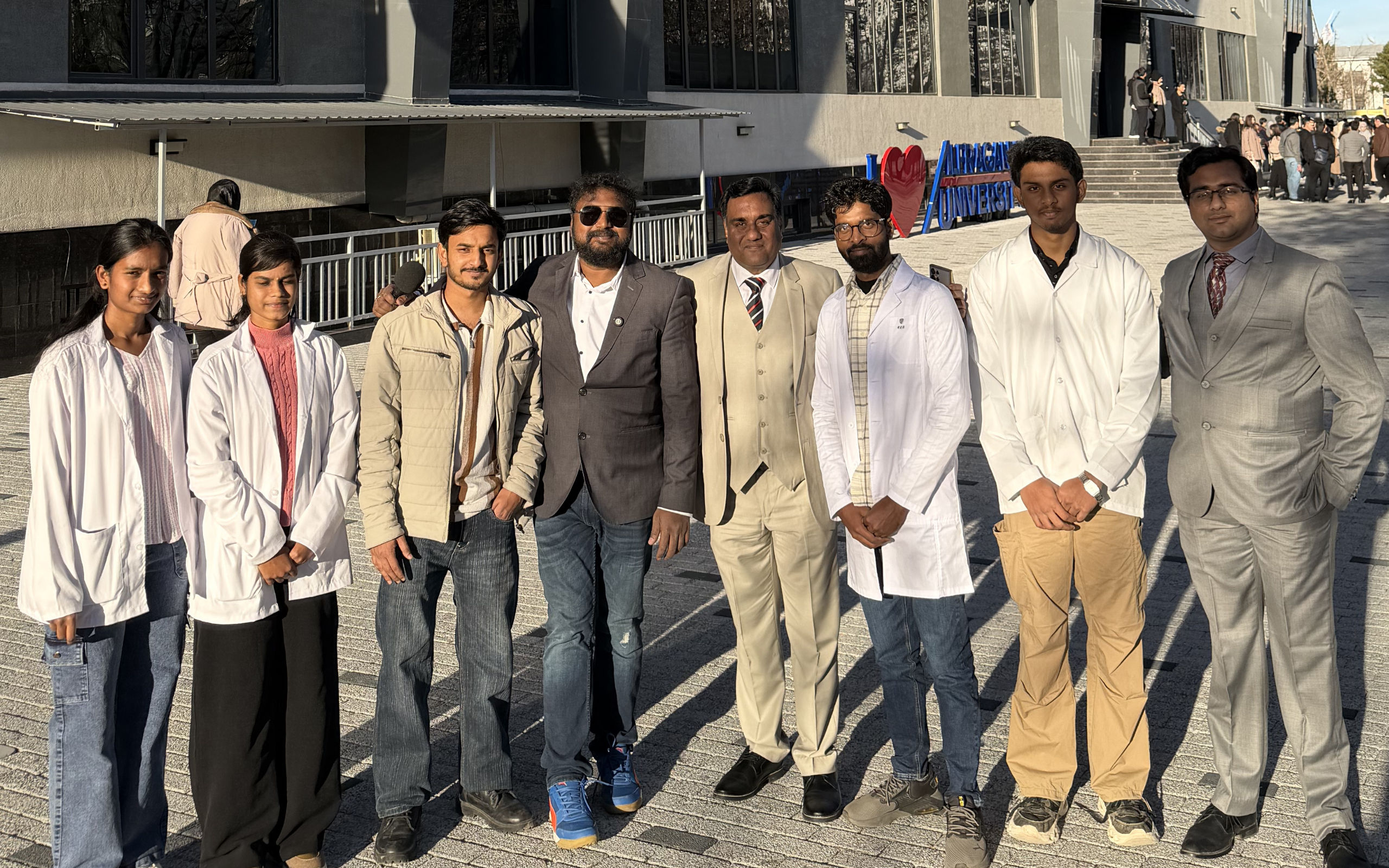
Before you read another word about the programme, listen directly from our students and get a glimpse of Alfraganus University — the campus, the classrooms, and what studying medicine here is really like.
WHY ALFRAGANUS UNIVERSITY
The university is named after Ahmad Al-Fergani, the 9th-century astronomer and mathematician whose work shaped early world science. Today, its Faculty of Medicine sits within an eight-faculty university of around 22,300 students from across the world. Students train on a modern Tashkent campus and complete clinical rotations at the university's own multispecialty hospital. The medical degree is listed in the WHO World Directory of Medical Schools and supports the FMGE, NExT, USMLE, and PLAB pathways for graduates.
2025-26 INTAKE AT A GLANCE
September 2025 (apply by last week of September)
5 years + 1 year internship (per NMC 2021 regulations)
English. No Russian/Uzbek needed for classes
50% in PCB (12th) + qualifying NEET score
Yunusabad District, Tashkent (capital city)
Every applicant receives the current year's fee structure, intake dates, and hostel charges in writing as part of our counselling process, so you always have the latest figures before taking the next step.
INSIDE THE CAMPUS
Alfraganus University combines a celebrated scientific heritage with a campus built for modern medical education. Here's a closer look at what students join.
A relatively new university, founded in 2022 and named after Ahmad Al-Fergani, a 9th-century astronomer and mathematician from the Fergana Valley. The Faculty of Medicine is part of its 8-faculty structure.
Alfraganus University describes its facilities as a 5th generation campus, combining modern academic infrastructure with sustainability principles, digital learning tools, and collaborative learning spaces. For medical students, this means simulation labs, digital classrooms, and practical learning environments designed for current medical education standards rather than retrofitted from older buildings.
Located at 2a Yukori Karakamish Street, Yunusabad District, Tashkent, a modern, residential part of Uzbekistan's capital with Metro access, markets, and Indian grocery stores nearby.
A thriving international community of around 22,300 students and 923 faculty members, across 47 study programmes and 37 specialisations. You'll be joining a campus with real momentum.
AFU operates its own hospital facility used for teaching and clinical exposure, which is important for NMC compliance on clinical training hours.
Alfraganus University maintains active cooperation with universities across Europe and Asia, and is listed in Times Higher Education and UI GreenMetric international university rankings.
Rector's scholarships and "Al-Fergani" merit scholarships are offered for high-performing students, including fee exemptions in subsequent academic years. Terms change, so ask for the current policy in writing.
WHY INDIAN FAMILIES CHOOSE ALFRAGANUS
The full 5+1 programme (including tuition, hostel, food, and travel) typically falls within ₹25 to ₹35 lakh. This is significantly lower than the cost of a private medical seat in most Indian states, leaving room in family budgets for post-graduation preparation later.
A 5-year medical programme + 1-year internship, in English, aligned with NMC's Foreign Medical Graduate Licentiate Regulations, 2021. Students are eligible to sit for FMGE, and NExT once it fully rolls out.
Every lecture, lab, and exam is delivered in English. The university also runs conversational Uzbek and Russian modules so you're confident on hospital rounds by the time clinical years begin.
Tashkent is between 2,600 and 3,000 km from most Indian cities, making it one of the more accessible MBBS destinations. Direct flights from Delhi take under three hours, with one-stop options available from other Indian cities via Delhi, Sharjah, or Dubai.
CLINICAL TRAINING
Clinical training is one of the most important factors families weigh when comparing MBBS programmes. Alfraganus University runs its own multispecialty hospital in Tashkent, which is where students complete their clinical rotations. Training inside a university-operated hospital is one of the elements NMC looks at when reviewing foreign medical qualifications, and it gives students consistent supervised exposure across the major specialties.
The teaching hospital covers more than thirty medical specialties, giving students rotations across internal medicine, surgery, paediatrics, obstetrics and gynaecology, cardiology, orthopaedics, and other core fields required by NMC's Foreign Medical Graduate guidelines.
Students begin observational hospital exposure in the early years and move into structured clinical rotations as the programme progresses. Working inside a single university-affiliated hospital simplifies attendance tracking, important documentation for FMGE eligibility on return to India.
Clinical teaching is delivered by faculty who are also practising doctors at the hospital, so students learn diagnostic reasoning and patient interaction alongside textbook knowledge. Patient-facing exposure is supervised throughout.
ELIGIBILITY CRITERIA
ADMISSION REQUIREMENTS
LIFE IN TASHKENT
Tashkent is a modern Central Asian capital with a steady Indian student community and good day-to-day infrastructure for new arrivals. Here's what to expect from daily life around campus.
Delhi → Tashkent direct is roughly 2h 50m. From most other Indian cities, typical one-stop routes connect via Delhi, Sharjah, or Dubai, with total travel of around 9–12 hours.
Tashkent has a steadily growing Indian restaurant scene and several Indian grocery stores stocking rice, dal, curry leaves, tamarind, and common masala mixes. Many hostels allow students to cook, and vegetarian and Jain-friendly options are manageable with some planning.
Tashkent has an active Indian student community across its medical universities, with student-run associations that organise festival celebrations and peer support. New students are rarely the only person from their region on campus.
Tashkent offers something most of India doesn't: crisp winters (−5°C to −10°C, Dec–Feb) and warm, dry summers up to 40°C. A one-time winter wardrobe of around ₹15,000–₹25,000 sets you up for the full programme.
Typical monthly expenses (hostel, food, transport, and mobile data) sit around ₹15,000–₹22,000. Far kinder to family budgets than most Indian metros, with room left over for books, travel, and the occasional weekend trip.
Everything academic happens in English. AFU also runs beginner Uzbek and Russian classes, so most students can hold their own on hospital rounds and in the city by the end of first year. A useful language to add to your CV.
FOR PARENTS
Sending a child abroad for medical school is a serious decision, and the questions parents ask are different from the questions students ask. This section is written for the parents reading this page, to address the practical concerns that matter most when your child is studying overseas for six years.
FROM CONSULTATION TO GRADUATION
From the first counselling call through to graduation, the Omeis team supports families across each stage of the process. Here's what's included.
STEP-BY-STEP SUPPORT
RECOGNITION YOU CAN TRUST
NEXT STEPS
A free consultation with an Omeis counsellor, at your pace. We'll review your eligibility, share the current fee structure in writing, and walk you and your family through the application timeline for the 2025-26 intake. No commitment is expected.
Book a Free Consultation